| Technical Consultation |
■Cleanroom
A cleanroom is a contamination-controlled environment and is essential in
the industrial manufacture of many electronic, semiconductor, optical,
pharmaceutical and medical products. The use of cleanrooms for the
manufacture of a large range of products such as microprocessors, CD
players, lasers, pharmaceuticals and medical devices continues to grow and
many companies are using cleanrooms for the first time. |
Comparison among every kind of
particle size

Particle Size(MICRON)
※Seiichi Denda(Kyoritsu Shuppan) |
|
■ Cleanroom level is classified under specific conditions.
The Cleanliness of a clean room is measured by the size and number of
dust particles in a given volume of air. The rating or classification
by the number of particles in a given volume of air and under specific
conditions is called cleanliness level class. Regulations vary from country.
The most used standard is US Federal standard 209E.
■ There are two standards for industrial cleanrooms.
In Japan, JIS B9920 and Federal Standard 209E are generally adopted as the
standards for industrial cleanrooms. The cleanliness level classes are
defined in JIS B9920 by the number of dust and particles with a diameter
0.1um or larger contained in one cubic meter of air. Class 3. for instance,
contains less then 10^3 (1000)0.1um particles in one cubic meter of air.
In Federal Standard 209E, the number of particles of diameter 0.5um or
larger contained in one cubic foot(1ft^3) is used.
■ Biological clean rooms treat biological particles.
Biological cleanrooms control the biological particles in the room. The
US National Space Aviation Bureau (NASA) Standard NHB-5340-2 specifies the
cleanliness level classes. The number of biological particles floating in
a given volume of air in the room (particles/ft^3)is counted, irrespective
of their size, as well as the number of biological particles falling on
a given area of the floor of the room, in a given time period
(particles/ft^3 x week). However, biological particles may propagate,
perish, or behave otherwise depending on environmental conditions other than
cleanliness, and hence no clear-cut specifications have been established.
|
Distribution curve of particle
size
■ 橫軸上代表塵粒大小的每立方呎含有塵粒數目之上限。
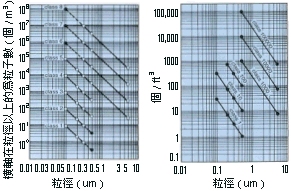
|
| ■ JIS B 9920 Upper Limit for Concentration for
Cleanliness Level Classes (pcs/m3) |
Particle size
(μm) |
Cleanliness Level Class |
| class 1 |
class 2 |
class 3 |
class 4 |
class 5 |
class 6 |
class 7 |
class 8 |
| 0.1 |
101 |
102 |
103 |
104 |
105 |
(106) |
(107) |
(108) |
| 0.2 |
2 |
24 |
236 |
2360 |
23600 |
‧‧‧‧ |
‧‧‧‧ |
‧‧‧‧ |
| 0.3 |
1 |
10 |
101 |
1010 |
10100 |
101000 |
1010000 |
10100000 |
| 0.5 |
(0.35) |
(0.3) |
35 |
350 |
3500 |
55000 |
350000 |
3500000 |
| 5.0 |
‧‧‧‧ |
‧‧‧‧ |
‧‧‧‧ |
‧‧‧‧ |
29 |
290 |
2900 |
29000 |
| Cleanliness Level
Class Particle Size Range |
0.1~0.3 |
0.1~0.5 |
0.1~5.0 |
0.3~5.0 |
|
| Remarks |
1. |
Classes 3,4,5,6,7 and 8 correspond to Federal Standard 209E (Cleanroom
and Work Station Requirements Controlled Environments)Classes,
1,10,1000,10000 and 100000 respectively. |
| 2. |
Upper
limit for concentration represents the concentration of particles of the
subject size or greater. |
| 3. |
Upper
limit for concentration is referenced to the value of particle sizes 0.1μand
0.5μm. |
| 4. |
Figures in parentheses are the values for the particle sizes other than
the subject size. They are given for evaluating the cleanliness level
classes and are for reference only. |
|
| ■ U.S. Federal Standard 209E Upper Limits for
Concentration for Cleanliness Level Classes Level Classes, Fed Std. (pcs/ft3) |
Particle
size
(μm) |
Cleanliness Level Classes |
| 1 |
10 |
100 |
1000 |
10000 |
100000 |
| 0.1 |
35
(1236) |
35
(12360) |
NA. |
NA. |
NA. |
NA. |
| 0.2 |
7.5
(265) |
75
(2649) |
750
(26486) |
NA. |
NA. |
NA. |
| 0.3 |
3
(106) |
30
(1059) |
300
(10594) |
NA. |
NA. |
NA. |
| 0.5 |
1
(35) |
10
(353) |
100
(3531) |
1000
(35315) |
10000
(353147) |
100000
(3531470) |
| 5.0 |
NA. |
NA. |
NA. |
7
(247) |
70
(2472) |
700
(24720) |
|
(NA-Not
Applicable),
( ) : Converted into the unit of pcs/m3
|
|
Suitable System For A Wide Range Of Applications And
Purposes.
|
ITEM\Type
of Cleanroom |
Conventional Cleanroom |
Horizontal
Laminar Flow Cleanroom |
Vertical
Laminar Flow Cleanroom |
|
Air Flow
System |
 |
 |
 |
|
Cleanliness Level |
10000~100000 |
1000~10000 |
class 100以下 |
|
Flexibility |
A process
which requires higher-level cleanliness needs to be positioned directly
under the air inlets. |
A process
which requires cleanliness needs to be positioned at the top of the air
stream. Flexibility is very limited. |
Flexibility is very high because maximum cleanliness is assured everywhere
in the room. |
|
Running
Cost |
Running
cost is low although high-level cleanliness is not obtained. |
Running
cost is relatively low because the air inlet rate is less than that of the
full vertical laminar flow system. |
Running
cost is highest due to the very high inlet rate. |
|
Running
Cost Index |
30 |
50 |
100 |
|
Construction Cost |
Low |
Fairly
High |
Highest
|
|
Construction Cost Index |
30 |
60 |
100 |
■Cleanroom
Facility
The quality of the products produced in cleanroom and the reject quota in
the microelectronics. Optics and pharmaceuticals industries depend on the
degree of cleanliness prevailing.
One of the decisive factors determining the effectiveness of a cleanroom,
however, is the quality of the ceiling, walls and floor forming the
encapsulation of the room.
Ceilings are constructed either as pure laminar flow filters or as blank
panels steel sheets on the T-Grid for turbulent mixed airflow. However,
walls must protect the cleanroom areas from normal production and office
areas (external enclosing walls) and at the some time keep sections with
different cleanliness requirements separate from one another. Different
clean air requirements involve different operating parameters. The wall must
be easily adaptable to rapidly changing manufacturing requirements.
|
|
|
|